This graph shows which files directly or indirectly include this file:
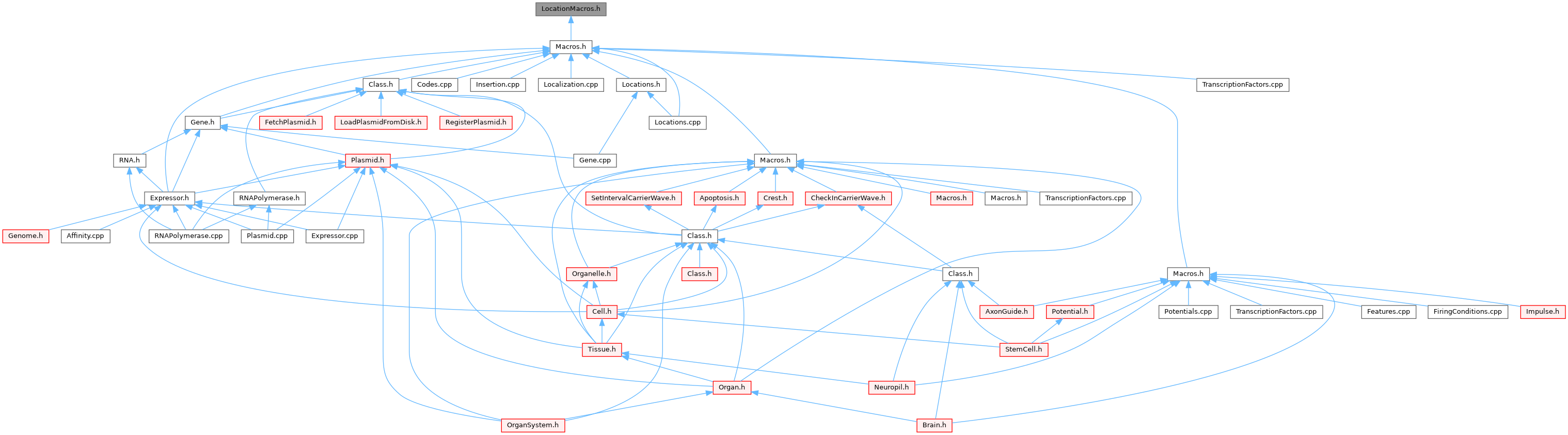
Go to the source code of this file.
Macros | |
| #define | BIO_TRANSLOCATION_FUNCTION(location, epitope, type, function, argTypeTuple, argTuple) |
| #define | BIO_LOCATION_FUNCTION_BODY(functionName, type) |
Macro Definition Documentation
◆ BIO_LOCATION_FUNCTION_BODY
| #define BIO_LOCATION_FUNCTION_BODY | ( | functionName, | |
| type | |||
| ) |
Value:
namespace location { \
BIO_ID_FUNCTION_BODY( \
functionName, \
::bio::genetic::Translocator::Instance(), \
BIO_TRANSLOCATION_FUNCTION( \
functionName, \
Move, \
type, \
GetByNameImplementation, \
(const Name&), \
(NULL)) \
BIO_TRANSLOCATION_FUNCTION( \
functionName, \
Insert, \
type, \
AddImplementation, \
(NULL)) \
}
Definition Pointer.h:115
Ease of use method of defining all kinds of sites at once.
This will automatically define peptidases (chemical::Excitation*) for the following affinities at your Location:
- "Move"
- "Insert"
◆ BIO_TRANSLOCATION_FUNCTION
| #define BIO_TRANSLOCATION_FUNCTION | ( | location, | |
| epitope, | |||
| type, | |||
| function, | |||
| argTypeTuple, | |||
| argTuple | |||
| ) |
Value:
bool g##location##epitope##Registered = \
SafelyAccess< ::bio::genetic::Translocator >() \
->AssociateSignalPeptidase( \
::bio::genetic::Translocator::Instance().GetIdFromName(#location), \
::bio::EpitopePerspective::Instance().GetIdFromName(#epitope), \
( \
new BIO_EXCITATION_CLASS( \
BIO_EXPAND_TUPLE argTypeTuple \
)( \
BIO_EXPAND_TUPLE argTuple \
) \
) \
);
Definition LinearMotif.h:133
This is not for you.