#include <EnvironmentDependent.h>
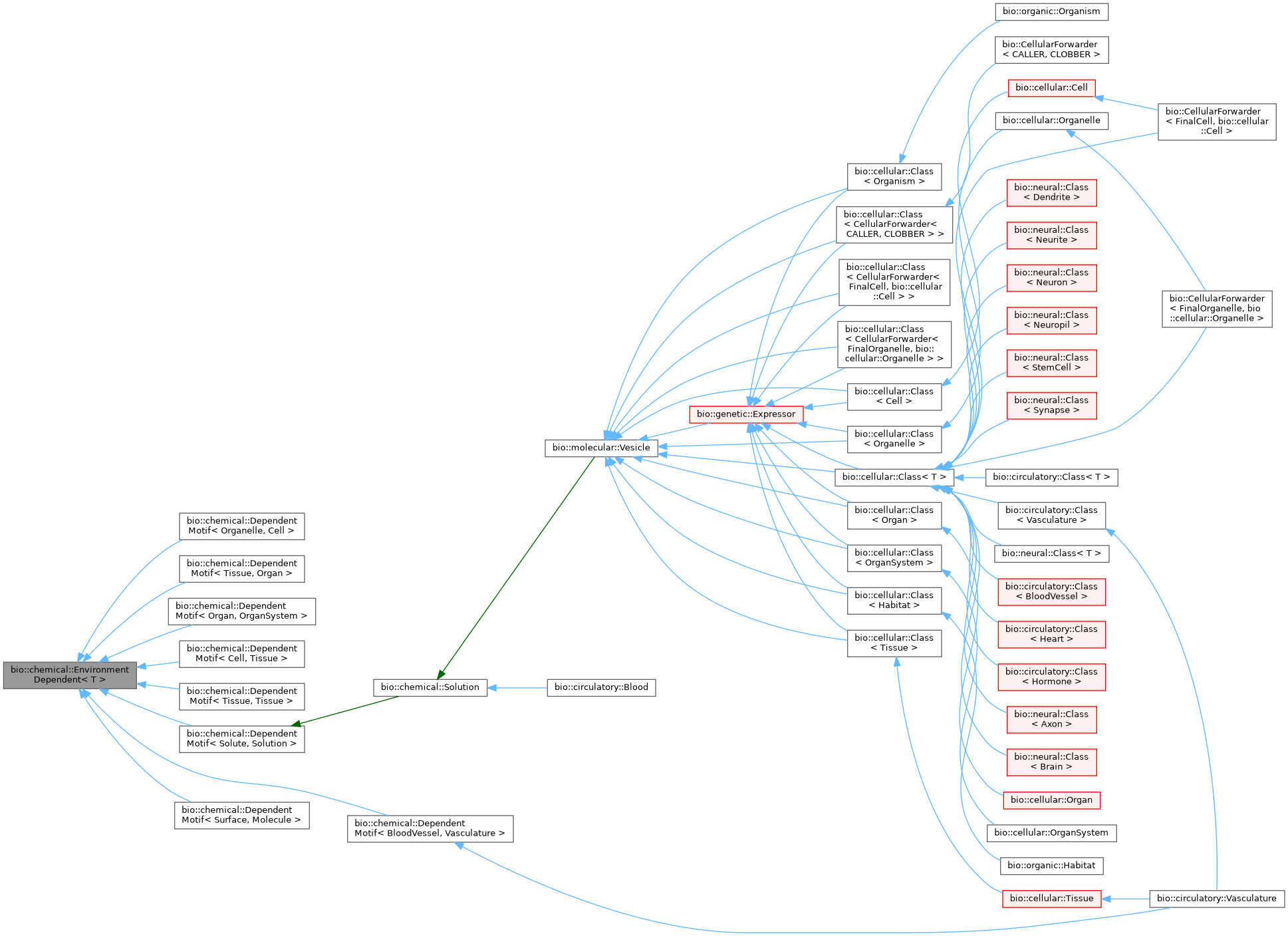
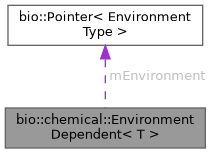
Public Types | |
| typedef type::RemovePointer< T >::Type | EnvironmentType |
| typedef Pointer< EnvironmentType > | EnvironmentPointer |
Protected Attributes | |
| EnvironmentPointer | mEnvironment |
Detailed Description
An EnvironmentDependent object is one that changes how it behaves based on where it exists.
This class assumes there is only ever 1 greater environment directly above the inheriting class.
For example, a Protein is dependent on the Cell in which it resides and a Cell is dependent on the Tissue in which it resides. However, no where is a Protein dependent on multiple Cells directly nor is any Cell dependent on more than 1 Tissue at a time. Instead, these EnvironmentDependent classes rely on their greater context to move between themselves and further contexts, whatever resources they need or produce. In other words, the immediate mEnvironment is a pivot point into the larger system & the larger system is often tiered, having an even larger system "above" it.
- Template Parameters
-
T domain object type that *this is dependent on. The stored value is Pointer<T>, matching the broader libbio convention that relationship templates name biological domains while pointer wrappers remain value/API details.
Member Typedef Documentation
◆ EnvironmentPointer
| typedef Pointer< EnvironmentType > bio::chemical::EnvironmentDependent< T >::EnvironmentPointer |
◆ EnvironmentType
| typedef type::RemovePointer<T>::Type bio::chemical::EnvironmentDependent< T >::EnvironmentType |
Constructor & Destructor Documentation
◆ EnvironmentDependent()
|
inline |
- Parameters
-
environment
◆ ~EnvironmentDependent()
|
inlinevirtual |
Member Function Documentation
◆ GetEnvironment() [1/2]
|
inlinevirtual |
- Returns
- The mEnvironment.
Reimplemented in bio::CellularForwarder< CALLER, CLOBBER >, bio::CellularForwarder< FinalCell, bio::cellular::Cell >, and bio::CellularForwarder< FinalOrganelle, bio::cellular::Organelle >.
◆ GetEnvironment() [2/2]
|
inlinevirtual |
- Returns
- The mEnvironment as const.
Reimplemented in bio::CellularForwarder< CALLER, CLOBBER >, bio::CellularForwarder< FinalCell, bio::cellular::Cell >, and bio::CellularForwarder< FinalOrganelle, bio::cellular::Organelle >.
◆ SetEnvironment()
|
inlinevirtual |
Sets mEnvironment.
Don't let the environment go out of scope or be deleted before *this!
- Parameters
-
environment
Member Data Documentation
◆ mEnvironment
|
protected |
The documentation for this class was generated from the following file: